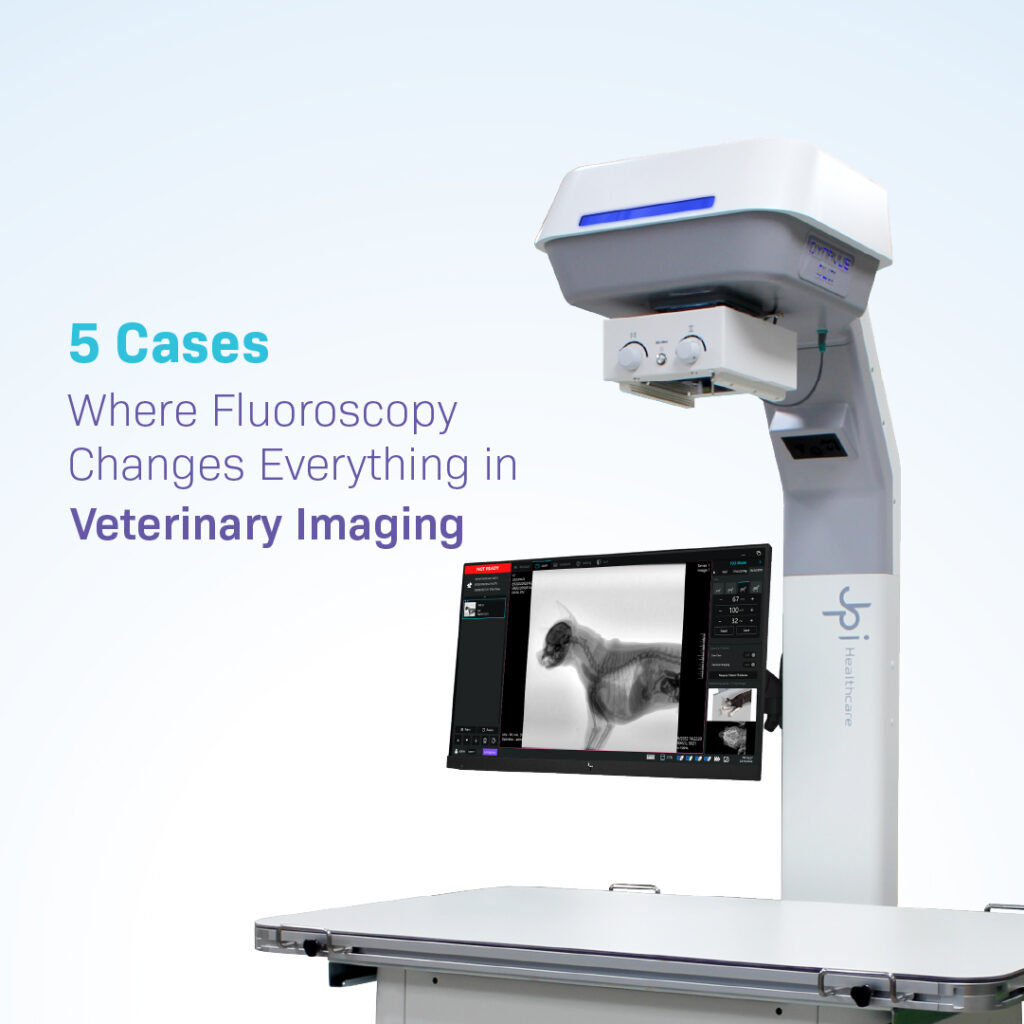
Some of the most challenging cases in practice aren’t the ones where imaging shows nothing, they’re the ones where imaging shows everything, and still doesn’t explain what’s happening.
The reason is simple: radiography captures anatomy. It cannot capture behavior, timing, or function, and that’s exactly what many of the hardest cases demand.
That’s where fluoroscopy changes the equation. Not by adding more images, but by adding the one thing static imaging can never provide: the ability to observe physiology as it happens.
The following five cases illustrate exactly where that shift from static to dynamic imaging doesn’t just add information, it fundamentally changes clinical decision-making.
1. Esophageal Disorders
Intermittent regurgitation, vague dysphagia, or suspected aspiration pneumonia, we’ve all seen cases where thoracic radiographs don’t fully explain the clinical signs.
Fluoroscopy allows you to evaluate the entire swallowing sequence in real time, including:
- Oral phase coordination
- Pharyngeal contraction
- Upper esophageal sphincter relaxation
- Esophageal peristalsis
Subtle abnormalities like delayed transit, segmental dysmotility, or transient aspiration events often go completely undetected on static studies.
Clinical impact:
- Confirms functional disorders (vs structural assumptions)
- Identifies aspiration risk during the exam itself
- Helps tailor feeding strategies and long-term management
2. Dynamic Airway Disease
Tracheal collapse and bronchomalacia are inherently dynamic conditions. The degree of collapse can vary significantly with:
- Respiratory phase
- Stress or excitement
- Patient positioning
Even well-timed inspiratory/expiratory radiographs can miss the true severity.
With fluoroscopy, you can assess airway diameter continuously throughout the respiratory cycle, and more importantly, correlate it with clinical signs like coughing or distress.
Clinical impact:
- More accurate grading of airway collapse
- Better differentiation between cervical vs intrathoracic involvement
- Improved decision-making for medical vs interventional management
3. GI Motility vs Obstruction: A Critical Distinction
Vomiting and suspected obstruction cases are where fluoroscopy often proves its value very quickly.
Traditional contrast studies can show progression — but they don’t show how that progression is happening.
Fluoroscopy lets you observe:
- Gastric emptying patterns
- Pyloric function
- Small intestinal motility
- Passage (or lack of passage) around a suspected foreign body
You can distinguish between true mechanical obstruction and functional ileus or delayed transit, which directly impacts whether a case goes to surgery.
Clinical impact:
- Reduces unnecessary exploratory surgeries
- Provides earlier confirmation of obstruction
- Allows more confident monitoring of borderline cases
4. Fluoroscopy-Guided Procedures
There’s a growing shift in veterinary medicine toward minimally invasive techniques — and fluoroscopy is central to that transition.
Whether placing feeding tubes, guiding contrast studies, or performing interventional procedures, real-time visualization eliminates much of the uncertainty.
Instead of relying on landmarks and post-placement confirmation, you’re actively guiding the process as it happens.
Clinical impact:
- Increased accuracy in catheter and tube placement
- Reduced procedure time and repeat attempts
- Lower risk of complications
For practices expanding into interventional work, fluoroscopy becomes not just helpful — but essential.
5. Functional Orthopedic Assessment
Orthopedic radiographs are excellent for identifying structural abnormalities — but they don’t always explain lameness.
In cases where imaging appears normal but clinical signs persist, fluoroscopy can be used to evaluate:
- Joint stability during movement
- Abnormal tracking or subluxation
- Functional biomechanics under load
This is particularly useful in subtle or intermittent conditions that don’t present clearly in static positioning.
Clinical impact:
- Adds a functional layer to orthopedic diagnostics
- Helps guide targeted treatment or rehabilitation
- Supports more confident case management when findings are inconclusive
Fluoroscopy: Bringing Function Into Focus
Fluoroscopy is about closing the gap between anatomy and function. Many of the most challenging cases in practice fall right into that space: the patient with persistent symptoms and inconclusive imaging, the borderline case where you’re weighing monitoring versus intervention, or the condition that changes with timing, movement, or physiology. In these moments, the ability to observe processes in real time can fundamentally shift your approach, not by adding more images, but by adding the context needed to make confident decisions.
As veterinary medicine continues to evolve, there is a clear move toward earlier and more precise diagnoses, minimally invasive techniques, and more efficient clinical workflows. Fluoroscopy supports all three, not as a niche capability, but as a practical extension of everyday imaging. For many clinics, the question is no longer if fluoroscopy is valuable, but when it becomes part of their diagnostic toolkit.
Curious to learn more about our Fluoroscopy solutions? Book a demo